


3 Ways Fleets Manage Tachograph Data – and Which One Works Best
Fleet managers search for the most efficient way to handle tachograph data, driver card downloads, and working‑time compliance. While the tools and workflows differ, fleets typically use one of three setups:
Manual downloads + tracking in notes or spreadsheets
Automated remote downloads using fleet management tools
Remote downloads combined with a tachograph analysis solution (e.g., Tachogram)
All three approaches technically meet compliance requirements. However, only one of them ticks all the boxes – reduces administrative workload, is scalable, and provides clear infringement, rest and work time insights. This article compares the three methods and explains why remote download + tachograph analysis is the wisest long‑term solution for logistics companies.
Why Choosing the Right Tachograph Workflow Matters
Companies don’t struggle to get their tachograph data – they struggle to manage, interpret, and use it. The wrong workflow leads to:
missed tachograph download deadlines for driver and vehicle cards
unclear legality reports and difficulty storing data
slow or incorrect payroll calculations
repeated questions from drivers about their infringements
manual corrections and a higher workload
A strong tachograph data analysis setup addresses these issues directly, rather than shifting them elsewhere.
1. Manual Downloads + Handwritten Notes
This traditional method remains common among smaller fleets that do not plan to expand or cross borders.
Advantages
No monthly software costs
Simple for one‑person operations
Works for companies with low mileage and few drivers
Limitations
High compliance risk: manual reminders often lead to late downloads or missing reports
Human error: interpreting EU rules manually leads to inconsistent calculations
Slow payroll: requires hours of reviewing spreadsheets or handwritten notes
No driver visibility: drivers rely entirely on managers for updates
Difficult to scale: once the fleet grows, this method becomes unmanageable
2. Automated Remote Downloads Without Tachograph Analysis
Some fleets upgrade only the first step: automating tachograph data collection. Remote downloads reduce time spent collecting data, but not the time spent understanding it. Tools like Mapon’s remote tachograph download support this workflow.
Advantages
Automatic tachograph and driver card downloads – no physical access needed
Reduces the risk of fines related to late downloads
Centralises files for tachograph compliance audits
Shows a simple summary of driving, rest and working time
Limitations
No legality interpretation: violations still need manual checking
More complex payroll calculations remain manual: only a simple working hour overview is available
Drivers cannot self‑check: managers still spend time answering every question
3. Remote Downloads + Tachograph Analysis
This is the workflow used by modern, compliance‑focused fleets. The approach is suitable for any transport and logistics company that wants to reduce admin load and maintain reliable long‑term compliance. The combination of Mapon's remote download tool and the tachograph analysis software Tachogram is a great option.
Advantages
Fully automated data collection: removes deadline stress completely
Instant tachograph legality checks: violations explained clearly, not hidden inside raw files
Accurate activity summaries: rest periods, driving time, border crossings, out-of-scope time, and more
Fast payroll preparation: organised records reduce calculation time significantly
Driver access: drivers can check their own hours, reducing inbound questions
Cross‑border accuracy: aligned with the EU Drivers’ Hours and Working Time rules
Why it scales
Larger fleets don't need to create more manual tasks
Managers focus on operational decisions, not data handling
Patterns become visible early, reducing the risk of recurring violations
The solution reduces paperwork, duplicated work, and time‑consuming checks
The insights from tachograph data can serve as a basis for driver coaching
Comparison Overview
Below is a clear side-by-side table comparing the three most common tachograph management methods.
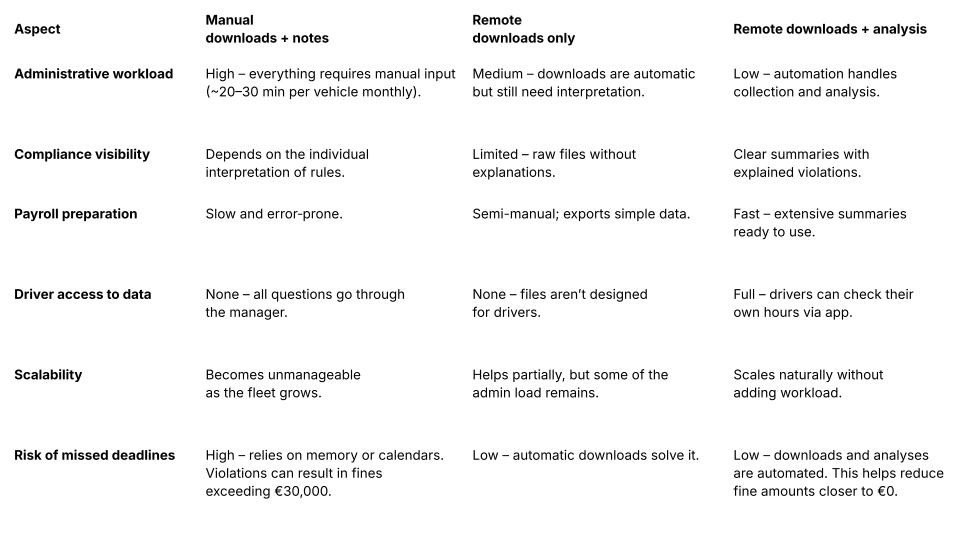
Most fleets begin with manual downloads because these methods seem straightforward. However, as operations expand and schedules become more complex, the weaknesses become apparent: missed deadlines, bare-minimum reports, repetitive data entry, and a stream of driver questions.
Remote downloads alone reduce part of the workload, yet they still leave managers interpreting raw files.
Combining remote download with a tachograph analysis system changes the workflow entirely. Data arrives automatically, is processed instantly, and is ready to use for an in-depth infringement analysis, salary calculations, workload planning, and more.
This setup shifts compliance from a stressful weekly task to a predictable, structured routine. It scales naturally, reduces administrative pressure, and allows managers to focus on critical decisions rather than data handling.
If you want to find out more about our tachograph analysis solution, contact us at [email protected]. Or if you are ready to get started, sign up for a free trial!